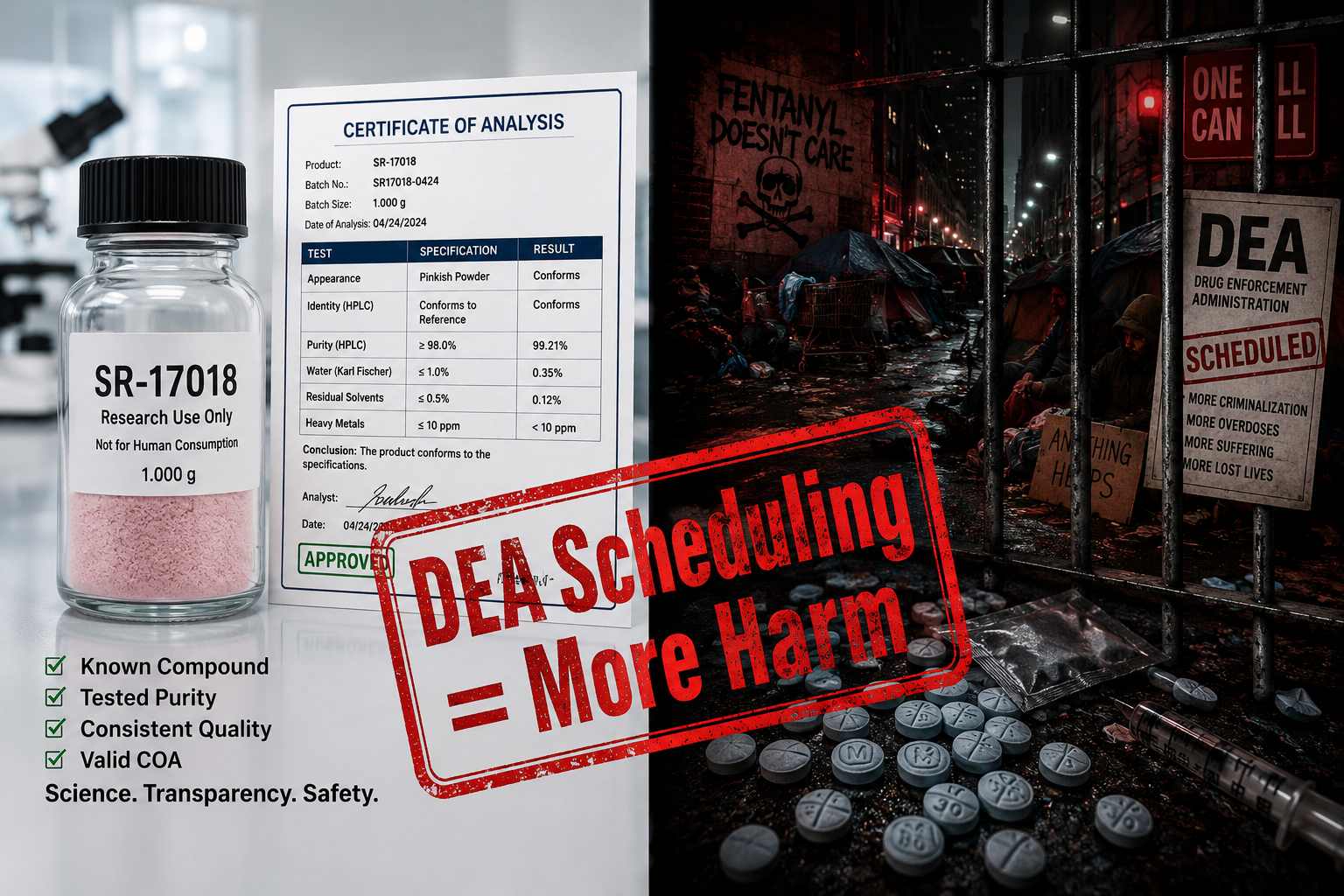
SR-17018: A Promising G-Protein Biased Research Tool That Could Help Combat the Opioid Epidemic — Why the DEA’s Push to Schedule It as Schedule I Is a Catastrophic Mistake
The United States is still in the grip of the worst opioid crisis in history. Hundreds of thousands have died from fentanyl and other synthetic opioids. Traditional full-agonist opioids rapidly produce tolerance, severe withdrawal, dependence, and high overdose risk.
SR-17018 (CAS 2134602-45-0), a synthetic mu-opioid receptor agonist developed at the Scripps Research Institute, works differently. It is G-protein biased — strongly favoring the G-protein signaling pathway while minimizing β-arrestin recruitment. This bias is associated with:
- Significantly reduced tolerance development
- Ability to reverse existing opioid tolerance
- Prevention of withdrawal symptoms in preclinical models
- Lower risk of respiratory depression compared to classical opioids
Yet the DEA is moving to place SR-17018 into Schedule I — the same category as heroin and LSD — claiming it has “no currently accepted medical use” and high abuse potential.
This decision is not just shortsighted. It is actively dangerous.
What the Research Actually Shows
Multiple peer-reviewed studies (including work from the Bohn lab at Scripps and follow-up publications) demonstrate that SR-17018:
- Maintains high affinity for the mu-opioid receptor (MOR) with strong G-protein bias.
- In morphine-tolerant mice, substitution with SR-17018 restored morphine potency, prevented withdrawal, and avoided the receptor adaptations that drive addiction.
- Shows a favorable profile in kratom and 7-hydroxymitragynine (7-OH) dependence models with minimal precipitated withdrawal.
- Supports structured taper protocols that many independent researchers have documented as smoother than traditional opioid replacement approaches.
On SR17Direct.com we provide educational resources including a free volumetric dosing guide, three-phase research protocol (calibration → stabilization → taper), and a taper calculator built specifically for laboratory research with this compound.
These tools exist because the preclinical data is compelling: SR-17018 has genuine potential as a bridge to help subjects move away from high-risk full agonists with less suffering and lower relapse risk.
The Real-World Consequences of Schedule I Placement
If the DEA succeeds in scheduling SR-17018 as Schedule I:
Legitimate research will be crippled. Universities and labs will face insurmountable regulatory barriers. Funding will disappear. Innovation in biased opioid agonists — one of the most promising areas in pain and addiction science — will stall for years.
People will return to the streets. Individuals currently using SR-17018 in structured research to taper from kratom, 7-OH, prescription opioids, or fentanyl analogs will lose access to a tested research material. Many will go back to unpredictable black-market drugs.
The opioid epidemic will get worse — exponentially. More uncontrolled withdrawal, higher relapse rates, more overdoses, and more deaths.
Prisons will fill with non-violent people. Researchers, self-experimenters, and small vendors of analytical reference standards will face federal felony charges. This repeats the failed “War on Drugs” playbook that has already cost billions and incarcerated millions without reducing addiction.
Homelessness will surge. Chronic users who lose a tool that helps them stabilize will remain trapped in active addiction. The downstream costs — emergency services, untreated mental health, survival crime, and family breakdown — will increase dramatically.
Prohibition of promising research compounds does not reduce harm. It manufactures harm.
A Smarter Approach
- Accelerate preclinical and clinical studies on G-protein biased agonists.
- Support open sharing of laboratory protocols, dosing data, and taper methodologies.
Important Notice: SR-17018 is sold strictly for laboratory research and analytical reference purposes. It is not approved for human consumption. All information on this site is for educational purposes only.
Take Action Now
The public comment period on this proposed scheduling is open for 30 days.
Submit your comment here: regulations.gov (search for SR-17018 or Docket ID DEA-2026-XXXX)
Sign the petition: Change.org – Stop the Scheduling of SR-17018
Share this article. Demand that policy be guided by preclinical evidence from Scripps and others — not by fear-driven blanket prohibition.
Further Reading on SR17Direct.com
- Complete SR-17018 Research Guide
- Three-Phase Taper Protocol for Laboratory Research
- Free SR-17018 Taper Calculator
- Volumetric Dosing & Solution Preparation Guide
- Kratom & 7-OH Withdrawal Research
References
- Grim et al., Neuropsychopharmacology (2020)
- Stahl et al., structural and pharmacological studies on biased agonists
- Bohn Laboratory / Scripps Research Institute publications
- Additional peer-reviewed papers on mu-opioid receptor bias and tolerance reversal